Saturday, October 12, 2013

C4T #2
C4T #1
In Doug Peterson's post Better Blogging he discusses how he did not always favor writing, but now that he is older his outlook has changed. He talks about how he enjoys writing and blogging now. However, he confesses that he is not that fond of proofreading and this tends to be very normal for most people. Doug begins his next paragraph with a question to his readers asking "What proofreading techniques work best when using blogs in the classroom?" Doug's blog post is intended to stir up your thought process and have you think about all the different ways you can become better at blogging..jpg)
I commented on his post and said that this really made me ponder. I also mentioned that I had recently learned about proofreading techniques in my EDM310 class and as individuals you really have to learn what works best for you. I spoke about how I had recently starting blogging and I truly enjoy it. Blogging is a technique I am going to use in my future classroom and I will be sure to teach many different proofreading methods as well. Overall, I found his blog to be very interesting and we all have similar questions like Mr. Peterson had.
C4T #2
In Doug Peterson's post Classroom Management Challenge he talks about how to quiet down a class. He mentions an article called "15 Creative & Respectful Ways to Quiet a Class" that provides a list of different techniques that deal more towards the elementary age group. His Twitter friend Linda Aragoni steps in and asks what techniques could be aimed towards the older age groups. Mr. Peterson discusses how he gives his kids the ownership of the society curriculum requirement and this tends to keep them focused on all the work they have to do. He also stated that just because a class is noisy does not necessarily indicate that it is "bad noise." He said that sometimes there is nothing better than students working in groups and discussing topics. These are noises that should not be affiliated with the disruptive one's.
I commented on his blog saying that this was a great topic to write about because it is a popular issue that many teachers deal with on a regular basis. I stated that I agreed with his Twitter friend Ms. Aragoni when she said most of the techniques mentioned in the article were aimed towards the young age group instead of older. However, it seemed that Mr. Peterson handled his older age group quite well from reading his blog post. I also agreed with how he stated that not all noises are considered "Bad Noises." Students are supposed to debate and work together among groups, which means at times your classroom will be filled with noise. His blog was very interesting and I thoroughly enjoyed reading it.
In Doug Peterson's post Better Blogging he discusses how he did not always favor writing, but now that he is older his outlook has changed. He talks about how he enjoys writing and blogging now. However, he confesses that he is not that fond of proofreading and this tends to be very normal for most people. Doug begins his next paragraph with a question to his readers asking "What proofreading techniques work best when using blogs in the classroom?" Doug's blog post is intended to stir up your thought process and have you think about all the different ways you can become better at blogging.
.jpg)
I commented on his post and said that this really made me ponder. I also mentioned that I had recently learned about proofreading techniques in my EDM310 class and as individuals you really have to learn what works best for you. I spoke about how I had recently starting blogging and I truly enjoy it. Blogging is a technique I am going to use in my future classroom and I will be sure to teach many different proofreading methods as well. Overall, I found his blog to be very interesting and we all have similar questions like Mr. Peterson had.
C4T #2
In Doug Peterson's post Classroom Management Challenge he talks about how to quiet down a class. He mentions an article called "15 Creative & Respectful Ways to Quiet a Class" that provides a list of different techniques that deal more towards the elementary age group. His Twitter friend Linda Aragoni steps in and asks what techniques could be aimed towards the older age groups. Mr. Peterson discusses how he gives his kids the ownership of the society curriculum requirement and this tends to keep them focused on all the work they have to do. He also stated that just because a class is noisy does not necessarily indicate that it is "bad noise." He said that sometimes there is nothing better than students working in groups and discussing topics. These are noises that should not be affiliated with the disruptive one's.

I commented on his blog saying that this was a great topic to write about because it is a popular issue that many teachers deal with on a regular basis. I stated that I agreed with his Twitter friend Ms. Aragoni when she said most of the techniques mentioned in the article were aimed towards the young age group instead of older. However, it seemed that Mr. Peterson handled his older age group quite well from reading his blog post. I also agreed with how he stated that not all noises are considered "Bad Noises." Students are supposed to debate and work together among groups, which means at times your classroom will be filled with noise. His blog was very interesting and I thoroughly enjoyed reading it.
Project #13 Lesson Plan One
Project Based Learning
Authors: Kynyetta Barren, Kristie Bell, Douglas Jarvis
This lesson plan addresses a presentation on the History of the United States and is intended for students in the twelfth grade. A period of two weeks is needed for preparation. Our students will be divided into six groups with four in each. Students will have the option to choose which century or historic event they would like as long as it evolved the United States in some way. The students must use the search engine iCurio for their research. They can present their project by a powerpoint, poster, youtube, re-enactment, or any other tool we have listed in the instructions. Finally, students will be required to present their group presentation to the class.
Project Overview
Project Calendar
PBL Rubric
Authors: Kynyetta Barren, Kristie Bell, Douglas Jarvis
This lesson plan addresses a presentation on the History of the United States and is intended for students in the twelfth grade. A period of two weeks is needed for preparation. Our students will be divided into six groups with four in each. Students will have the option to choose which century or historic event they would like as long as it evolved the United States in some way. The students must use the search engine iCurio for their research. They can present their project by a powerpoint, poster, youtube, re-enactment, or any other tool we have listed in the instructions. Finally, students will be required to present their group presentation to the class.

Project Overview
Project Calendar
PBL Rubric
Saturday, October 5, 2013
Blog Post #7
Authors: Kristie Bell, Kynyetta Barren, and Doug Jarvis
PBL Part One:
In the interview with Dr. Strange and guest Anthony Capps, they discuss project based learning. Anthony shares his experience about doing PBL with his third grade class. He states that the goal of PBL is for them to own their own learning. The goal of a good project is to have an authentic audience so they are motivated to do good work. Another quality is that the project must peak the student interests and be relevant to their lives so they get that real world experience. The project must also revolve around the common core standards and actually teach them content that the state requires them to know.
What we can learn from this conversation is that it is important to keep our students motivated and interested in their work. We have to think outside the box and be creative with PBL. As an educator, we also need to understand that PBL is not about what the students achieve, but what they are learning. PBL is about reaching out to the students and allowing them to enjoy learning. This type of learning is meant to make an impact on their future and teach them how to achieve goals in the workplace instead of being forgotten information once the class has ended.
PBL Part Two:
In PBL not everything is going to go as we plan and sometimes we have to emphasize if “Plan A,” should fail. However, in some cases the outcome could turn out to be even better than expected. For example, Anthony Capps had his students write a narrative script as if they were a kid in Afghanistan. This project turned out to be one of his favorite projects because the children delivered so much variety. The outcome was phenomenal because these students really explored their options and did research. Some of his students went as far as focusing on the food they eat and how they have to grow the crops. The only issue in the classroom was that one of the students was not allowed to participate in this project because his father had served in Afghanistan, and did not feel comfortable with his son learning about this particular subject. Mr. Capps resolved this right away by letting him do an alternate science project and it turned out great.
What we can learn from this conversation is that PBL is a lot of hard work, but it certainly pays off in the end. There are many hours of extra work that goes into this type of teaching method, but seeing your student’s high scores is the best reward an educator can receive. There will also be times when we have to accommodate student’s with alternate options like Mr. Capps had to do, but that is how PBL was intended to be used. Just imagine how many students lives we could change if they truly enjoyed what they were learning. PBL really should be implemented into every grade level and we could change the way of thinking one step at a time.
Icurio
Icurio is strictly filtered and provides access to only safe websites for students to do research for their educational purposes. It also is an easy way to store and organize virtual files. iCurio is a personalized way of learning that accommodates each student’s individual needs. Students also have access to the content and tools they need to take charge of their own independent learning.
Discovery Ed
Anthony Capps states that Discovery Ed is a great visual aid resource because students can use videos to enrich their research experience. Students will be able to use visual aids to gain knowledge about their learning content. Discovery Ed brings experts into the classroom via video and allows students to obtain credible information for PBL.
Additional Thoughts About Lessons
By: Kristie Bell
Anthony Capps states that a lesson is four layers thick and we need to make sure we are very precise about this. The first layer should be about how the lesson fits in a year time frame and making sure you are covering all of the standards that are required by the state. The next focus is the unit size plan and making sure that the lesson is scaled properly. The third is called the week plan and you need to have goals to make sure you are getting everything done in that time period. You also have the daily lesson plan that focuses on how you deliver information to the students and it is very important. The daily plan focuses on making sure you have an attention hook for your students and keeping them engaged while you are delivering the content. Then you must have something afterwards to actually measure what they have learned in that day so you know where to pick up the next day. These are the four components to make one successful lesson plan.
Don’t Teach Tech Use It
By: Kynyetta Barren
In Dr. Strange and Anthony Capps’ video, Don’t Teach Tech Use It, Anthony talks about technology in his classroom. An important way to incorporate technology into the classroom is to use different tools. He stated to start with doing small reflection on iMovie one week and then have them create a movie the next week. By using technology such as iMovie, it gives the students the opportunity to learn how to create and share their projects with different students around the world. As students begin using technology, they become excited about the lessons being presented to them. Students learn more from being involved in using technology. Don’t expect greatness because we are all still learning new technology. Use It, Don’t Teach Tech!
What can be learned from the video “The Anthony Strange List of Tips for Teachers Part-1”
By: Douglas R Jarvis Jr.
In this video, Anthony Capps and Dr. John Strange engage in a conversation regarding insights and tips that can be beneficial to a young educator. First on their list was the idea that to be a solid teacher you must be a lifelong learner yourself. This is definitely true. New information is always being learned. What we may have thought to be the best way to do something today simply may not be true for tomorrow. Theories are proven wrong and new techniques replace old and ineffective ones. In order for us to be the best at what we do, we must be willing to learn and change with the times. Secondly, they discussed the fact that teaching can be hard so why not find a way to make it fun. This is a wonderful idea. Many times we become bogged down and begin to dread tasks because we lose the joy in it. So to avoid that feeling becoming part of our mindset as educators; we need to find new and exciting ways to present the material so that we are as excited to deliver it as our students are to learn it from us. Next, the importance of flexibility was discussed. We never know what unexpected challenges await us in life. Adapting to change and learning to be innovative and creative with your lesson plans can allow us to overcome life’s little curve balls and keep our classrooms on track. The fourth principle that was discussed is the importance of engaging our students. No one wants to do the same thing everyday. To really excite our students we need to find content and lesson plans that allow them to be creative in a way that allows them to demonstrate their understanding of the material we are presenting to them. Make it something that is a learning experience and also something they can be proud that they created. when students are given opportunities to show off their work, there is a sense of pride that drives them to put a little more into the project. Lastly, reflection was discussed. Listen to your students, take into consideration their opinions on the lessons you design. Learn from what they like and what they do not. By understanding what they believe works best for them, we can create more effective lessons that will be relevant and exciting for our students. By doing this, we can be better teachers.
PBL Part One:
In the interview with Dr. Strange and guest Anthony Capps, they discuss project based learning. Anthony shares his experience about doing PBL with his third grade class. He states that the goal of PBL is for them to own their own learning. The goal of a good project is to have an authentic audience so they are motivated to do good work. Another quality is that the project must peak the student interests and be relevant to their lives so they get that real world experience. The project must also revolve around the common core standards and actually teach them content that the state requires them to know.

What we can learn from this conversation is that it is important to keep our students motivated and interested in their work. We have to think outside the box and be creative with PBL. As an educator, we also need to understand that PBL is not about what the students achieve, but what they are learning. PBL is about reaching out to the students and allowing them to enjoy learning. This type of learning is meant to make an impact on their future and teach them how to achieve goals in the workplace instead of being forgotten information once the class has ended.
PBL Part Two:
In PBL not everything is going to go as we plan and sometimes we have to emphasize if “Plan A,” should fail. However, in some cases the outcome could turn out to be even better than expected. For example, Anthony Capps had his students write a narrative script as if they were a kid in Afghanistan. This project turned out to be one of his favorite projects because the children delivered so much variety. The outcome was phenomenal because these students really explored their options and did research. Some of his students went as far as focusing on the food they eat and how they have to grow the crops. The only issue in the classroom was that one of the students was not allowed to participate in this project because his father had served in Afghanistan, and did not feel comfortable with his son learning about this particular subject. Mr. Capps resolved this right away by letting him do an alternate science project and it turned out great.
What we can learn from this conversation is that PBL is a lot of hard work, but it certainly pays off in the end. There are many hours of extra work that goes into this type of teaching method, but seeing your student’s high scores is the best reward an educator can receive. There will also be times when we have to accommodate student’s with alternate options like Mr. Capps had to do, but that is how PBL was intended to be used. Just imagine how many students lives we could change if they truly enjoyed what they were learning. PBL really should be implemented into every grade level and we could change the way of thinking one step at a time.
Icurio
Icurio is strictly filtered and provides access to only safe websites for students to do research for their educational purposes. It also is an easy way to store and organize virtual files. iCurio is a personalized way of learning that accommodates each student’s individual needs. Students also have access to the content and tools they need to take charge of their own independent learning.

Discovery Ed
Anthony Capps states that Discovery Ed is a great visual aid resource because students can use videos to enrich their research experience. Students will be able to use visual aids to gain knowledge about their learning content. Discovery Ed brings experts into the classroom via video and allows students to obtain credible information for PBL.

Additional Thoughts About Lessons
By: Kristie Bell
Anthony Capps states that a lesson is four layers thick and we need to make sure we are very precise about this. The first layer should be about how the lesson fits in a year time frame and making sure you are covering all of the standards that are required by the state. The next focus is the unit size plan and making sure that the lesson is scaled properly. The third is called the week plan and you need to have goals to make sure you are getting everything done in that time period. You also have the daily lesson plan that focuses on how you deliver information to the students and it is very important. The daily plan focuses on making sure you have an attention hook for your students and keeping them engaged while you are delivering the content. Then you must have something afterwards to actually measure what they have learned in that day so you know where to pick up the next day. These are the four components to make one successful lesson plan.

Don’t Teach Tech Use It
By: Kynyetta Barren
In Dr. Strange and Anthony Capps’ video, Don’t Teach Tech Use It, Anthony talks about technology in his classroom. An important way to incorporate technology into the classroom is to use different tools. He stated to start with doing small reflection on iMovie one week and then have them create a movie the next week. By using technology such as iMovie, it gives the students the opportunity to learn how to create and share their projects with different students around the world. As students begin using technology, they become excited about the lessons being presented to them. Students learn more from being involved in using technology. Don’t expect greatness because we are all still learning new technology. Use It, Don’t Teach Tech!

What can be learned from the video “The Anthony Strange List of Tips for Teachers Part-1”
By: Douglas R Jarvis Jr.
In this video, Anthony Capps and Dr. John Strange engage in a conversation regarding insights and tips that can be beneficial to a young educator. First on their list was the idea that to be a solid teacher you must be a lifelong learner yourself. This is definitely true. New information is always being learned. What we may have thought to be the best way to do something today simply may not be true for tomorrow. Theories are proven wrong and new techniques replace old and ineffective ones. In order for us to be the best at what we do, we must be willing to learn and change with the times. Secondly, they discussed the fact that teaching can be hard so why not find a way to make it fun. This is a wonderful idea. Many times we become bogged down and begin to dread tasks because we lose the joy in it. So to avoid that feeling becoming part of our mindset as educators; we need to find new and exciting ways to present the material so that we are as excited to deliver it as our students are to learn it from us. Next, the importance of flexibility was discussed. We never know what unexpected challenges await us in life. Adapting to change and learning to be innovative and creative with your lesson plans can allow us to overcome life’s little curve balls and keep our classrooms on track. The fourth principle that was discussed is the importance of engaging our students. No one wants to do the same thing everyday. To really excite our students we need to find content and lesson plans that allow them to be creative in a way that allows them to demonstrate their understanding of the material we are presenting to them. Make it something that is a learning experience and also something they can be proud that they created. when students are given opportunities to show off their work, there is a sense of pride that drives them to put a little more into the project. Lastly, reflection was discussed. Listen to your students, take into consideration their opinions on the lessons you design. Learn from what they like and what they do not. By understanding what they believe works best for them, we can create more effective lessons that will be relevant and exciting for our students. By doing this, we can be better teachers.

Thursday, October 3, 2013
PLN Project #2 Progress Report #1
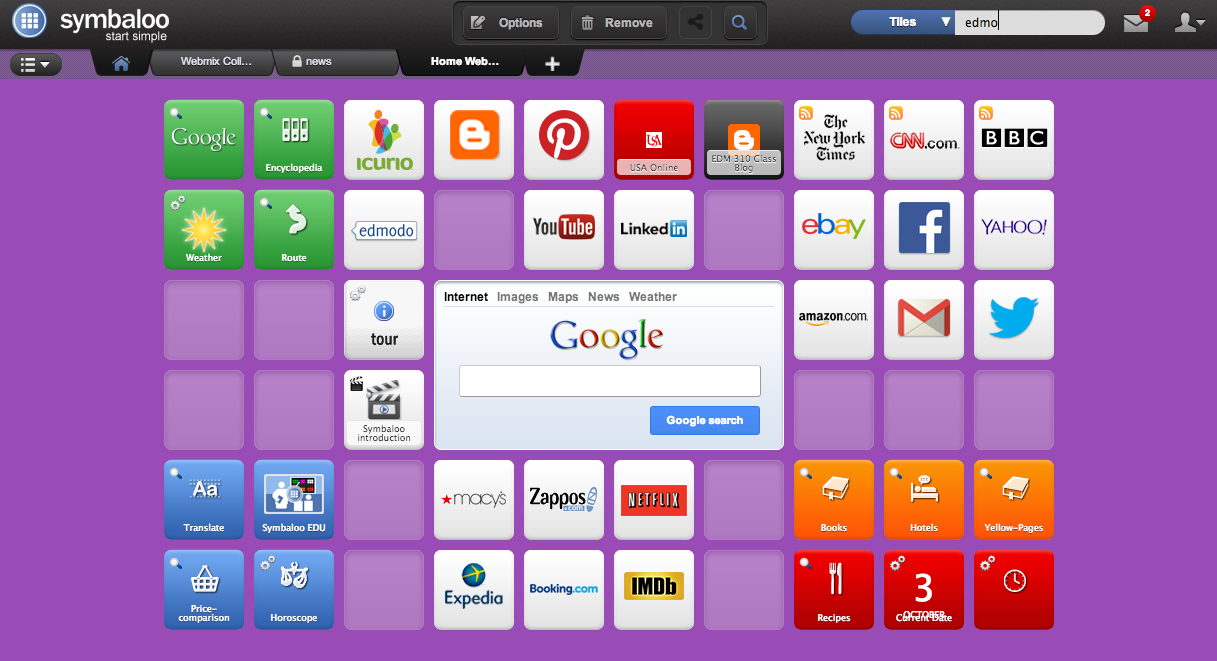
I have had a really great experience with PLN so far. For the first time, I made an account on Symbaloo and found it to be a very easy tool to use. Symbaloo provides easy access to the sites that you constantly use and keeps them organized in one specific area. I added some of the websites that I use on a daily basis such as Gmail, Twitter, Facebook, and Blogger. I also added an educational website that I use currently at my college called USA Online and the majority of students use this on a daily basis. This site has links to our online homework, power points, and displays our grades. On Symbaloo, I also added some other educational tiles that I recently learned about and I hope to use them in the future. I added Icurio and Edmodo.
These few tiles may be a small start, but I definitely plan on continuing to build my Symbaloo account. I absolutely love the organization of this site and I found it to be a very useful resource. I will certainly use this in the future because I believe it would be very beneficial to my future career.

C4K Summary Post (September)
C4K #1
 The first student I was assigned to was The Ginger Kid who wrote a blog post called This I Believe. His post was about games and the impact they had on his life. He discusses how he believes in games and their abilities to bring people closer together and work along side each other. In the post he also talks about how he has been going to leadership and teamwork camps over the past few years and how they use games to learn how to work together. After, reading this post I can certainly tell that this is something he is truly passionate about and believes in.
I left a comment on this blog post saying that I thought this was a really neat post! I talked about how important teamwork and leadership skills are and that these are great skills to possess. The fact that he participates in a camp like this is absolutely wonderful and will really help him in his path to success. Overall, I really enjoyed learning about his experience at this kind of camp and that he should keep up his great attitude.
C4K #2
 My second assignment was to comment on Hallie's blog Try and Guess What I Am!. She had to write a point of view blog and I had to identify which one she used. She used first person and her post was about the ocean. The blog post was about coral, seaweed, and even a shark. It seems that everybody was stumped on trying to figure out what is was and my best guess was a Mermaid.
I commented on Hallie's post and said that she used very descriptive sentences in her post and that helped me to paint a vivd image in my head. I thought it was an interesting post and told her to keep up the good work.
C4k #3
 My third comment was for a fifth grader named Harlem who attends Pt England school. His blog post was called Ask Eddie and he used google drawings to tell us about a powhiri. A powhiri is a welcoming ceremony and it can be held anywhere in New Zealand. People sing and even say speeches during these ceremonies.
I commented saying that I loved his blog! It was very creative and taught me something new because I have never heard of these ceremonies before. I also liked the picture that he used for his blog post and I told him to keep up the great work!
C4k #4
 My kid that I was assigned to this week was a girl named Emily who is in Mr. Rhodus's Sixth Grade Class. Her blog post was called Do Birds Get Shocked When They Sit On Wires!. In her post she lets her audience know that birds do not get shocked because their cells and tissues do not offer electrons.
I commented on her post saying that it is neat how birds do not get shocked when they sit on wires. I also said that is a great thing because it keeps the birds from getting injured. I thought her blog post was very informative and interesting.

I left a comment on this blog post saying that I thought this was a really neat post! I talked about how important teamwork and leadership skills are and that these are great skills to possess. The fact that he participates in a camp like this is absolutely wonderful and will really help him in his path to success. Overall, I really enjoyed learning about his experience at this kind of camp and that he should keep up his great attitude.
C4K #2

I commented on Hallie's post and said that she used very descriptive sentences in her post and that helped me to paint a vivd image in my head. I thought it was an interesting post and told her to keep up the good work.
C4k #3

I commented saying that I loved his blog! It was very creative and taught me something new because I have never heard of these ceremonies before. I also liked the picture that he used for his blog post and I told him to keep up the great work!
C4k #4

I commented on her post saying that it is neat how birds do not get shocked when they sit on wires. I also said that is a great thing because it keeps the birds from getting injured. I thought her blog post was very informative and interesting.
Saturday, September 28, 2013
Blog Post #6
Asking Questions: What questions do we ask? How do we ask?
Asking questions is necessary when teaching because it deepens and extends the student's way of thinking. Questions allow educators to make sure their students are comprehending the material and that they are helping their learning experience. However, the biggest problem with questions is that most of the time they can do more harm than good because we are not using them the correct way. After really doing some reading I learned more about the correct techniques and how we should ask questions.

In Ben Johnson's The Right Way To Ask Questions in the Classroom, he explains what type of questions we should be avoiding. How many of you have heard the question "Does everybody understand?" You are most likely thinking in your head about the countless number of times you have been asked this pointless question. In fact, the majority of you probably even said yes to this question even though you did not understand at all. As teachers we feel that this question is letting students know this is their last chance to ask for help, but in reality it does not push the students into the higher-order-thinking stratosphere. Teachers need to ask more specific questions instead of throwing these general questions to the air in the course of a class period. If you tend to be more specific it helps avoid one worded responses and promotes "open" questions instead, which lead to more feedback from your students.
Another effective approach when asking questions is to prepare them ahead of time. In Maryellen Weimer's Three Ways to Ask Better Questions in the Classroom she goes into depth about the importance of preparing before hand. Mary mentions an article by Bill Welty who said "When you write out a question, you can make it clearer...not just the wording, but clearer conceptually. Is it the question that needs to be asked? When is the best time to ask it?" These are just a few reasons why preparing questions is such a good idea. As teachers, it is very crucial that we work on our questioning techniques and ask good questions so that our students can see the importance of them.

Thursday, September 26, 2013
Saturday, September 21, 2013
Sunday, September 15, 2013
Blog Post #4
Langwitches' blog post Podcasting With First Graders is about a group of students who started reading Vacation under the Volcano by Mary Pope Osborne from the Magic Tree House series. The idea was to make believe that they are interviewing the two main characters. The students were eager to record several segments and enjoyed listening to their audio recording repetitively. The students also cared about the quality of their work because they asked to record their podcasts again if they were not pleased with the results. Even the most timid students were breaking out of their shells and joining in on the excitement.

The children learned the following skills:
listening
speaking
presenting
comprehension
storytelling
performance
voice acting
oral fluency
media
technology
Langwitches' blog post Flat Stanley Podcast is about a first grade class that reads the book Flat Stanley by Jim Brown. The class brainstorms with their teacher and comes up with a story line for their audio segment. They would be flattened by their SmartBoard and mailed around the world. They picked a location of their choice and had to borrow a book from the library so they could learn more about their place. They also had the option to use the internet to research their location. Together, with their parents they read their book and created a short script. The students were reminded that they needed to think about the senses and sound effects in their audio segment. This podcast made by these first graders really made me realize that sound effects and tone are an important part of audio. I would love to use this method of teaching in my future classroom.
Langwitches' blog post Listening-Comprehension-Podcasting is about a group of second graders who were learning the story of Purim. The students had to record the story as a podcast and their Jewish studies teacher helped them write their individual parts in Hebrew to create a script. The class had to unite as a team and make sure the entire story was told between them. The teacher had to make sure all of the recordings were completely out of order for this group project. The students then had to work together as a team and put the recordings in the correct order. They listened to the clips over and over again while they decided where to move each one. In the process of arranging the clips they were learning the sentences in English and Hebrew as well. After listening to this podcast I can really tell the children had a great time being creative. This was a great example of integrated learning and I think this is a fantastic tool to use in the classroom. I have learned that podcasting can offer an innovative way of learning and I am very excited about creating my first one.

The children learned the following skills:
Langwitches' blog post Flat Stanley Podcast is about a first grade class that reads the book Flat Stanley by Jim Brown. The class brainstorms with their teacher and comes up with a story line for their audio segment. They would be flattened by their SmartBoard and mailed around the world. They picked a location of their choice and had to borrow a book from the library so they could learn more about their place. They also had the option to use the internet to research their location. Together, with their parents they read their book and created a short script. The students were reminded that they needed to think about the senses and sound effects in their audio segment.

Langwitches' blog post Listening-Comprehension-Podcasting is about a group of second graders who were learning the story of Purim. The students had to record the story as a podcast and their Jewish studies teacher helped them write their individual parts in Hebrew to create a script. The class had to unite as a team and make sure the entire story was told between them. The teacher had to make sure all of the recordings were completely out of order for this group project. The students then had to work together as a team and put the recordings in the correct order. They listened to the clips over and over again while they decided where to move each one. In the process of arranging the clips they were learning the sentences in English and Hebrew as well. After listening to this podcast I can really tell the children had a great time being creative. This was a great example of integrated learning and I think this is a fantastic tool to use in the classroom. I have learned that podcasting can offer an innovative way of learning and I am very excited about creating my first one.

Wednesday, September 11, 2013
C4T #1
My teacher that I was assigned to is Ms. Andrea Hernandez. She teaches fourth and fifth grade language arts in Florida. Her students use technology in the classroom on a regular basis, like the ipad for example. She also has a very interesting No Homework Policy which I think you will find to be a very neat blog post. However with that said, she does encourage her students to read and write at home regularly. You should certainly check out her blog for yourself. It is very informative and creative with technology.
C4T Comment 1
 The first week I commented on the blog Five Apps I'm using in my Classroom. In the blog she explains that she is an elementary teacher who has an ipad friendly learning environment for her students. She lets her children use apps such as words with friends which is an educational game that associates with spelling. She has a set of guidelines for her students that only allows them to use their electronic devices for educational purposes. She also uses pandora and lets her kids listen to soothing music while they work on their assignments.
C4T Comment 2
I Hope You Like It! was the second blog post by Andrea Hernandez that I commented on. Andrea discusses in the beginning how we are always receiving information whether it is from a social media site or an email subscription. We all decipher which pieces of information are worth our time and for the most part it is a personal choice. We all tend to look for information that is meaningful and can benefit us in different ways. Andrea also takes the time to talk about how more teachers and students should blog. I have to say that I completely agree with this. Blogging allows people to connect, learn, and create. As Andrea states, "We are all writing and creating for our readers," and we simply want our readers to enjoy what we talk about..jpg)
C4T Comment 1

C4T Comment 2
I Hope You Like It! was the second blog post by Andrea Hernandez that I commented on. Andrea discusses in the beginning how we are always receiving information whether it is from a social media site or an email subscription. We all decipher which pieces of information are worth our time and for the most part it is a personal choice. We all tend to look for information that is meaningful and can benefit us in different ways. Andrea also takes the time to talk about how more teachers and students should blog. I have to say that I completely agree with this. Blogging allows people to connect, learn, and create. As Andrea states, "We are all writing and creating for our readers," and we simply want our readers to enjoy what we talk about.
.jpg)
Tuesday, September 10, 2013
Thursday, September 5, 2013
Blog Post #3
How Can You Provide Meaningful Feedback to Your Peers?
The word edit by itself is not a very intimidating word, but how about if I put peer in front of it? How many of you are suddenly a little worried now? For most people, critiquing their peers is not an easy task because we often tend to worry about offending one another. We take criticism in such a different way when it is coming from someone our own age rather than an instructor. Why is that? It feels as if we are being judged or even sized up at times because these are people we know and even if we do not know them well it still does not make it any easier. We have recently learned that in Dr. Strange's EDM310 class we are given groups and must edit our peers' blog posts. This was not an easy task for me because I have always been a sugar coater as some would label it. However, after watching the required material for this blog post, it demonstrates some ways that make peer editing seem more appealing and constructive. Since peer editing has always been a weakness for me, I really believe that this is why I enjoyed the material that, Dr. Strange, required we watch and read for this blog post. The first required activity was a video that explained what peer editing was: . Then we were asked to view a peer edit tutorial slideshow: . The last piece of material was a humorous video about the top ten mistakes that occur when peer editing: .
The video about "What is Peer Editing?"
In this video, I learned that peer editing can be used very effectively if we follow the three basic steps which was compliments, suggestions, and corrections. The most important rule about comments and compliments was to always stay positive. You have to imagine how it would feel if somebody your own age was critiquing your work, you would not want to read negative comments. The video demonstrated some techniques that I like to use, for example it asks that you point out your peer's strong points first instead of just going straight into corrections. When you do not acknowledge the parts they did well on it ends up discouraging that person, so that is why compliments are so crucial when editing. The next step was suggestions and how to formally present ideas to your peer about how to better their writing in a positive way. You are suppose to look at word choice,sentence structures, organization, topic, and details. The last step was to correct your peer's writing and you are supposed to look at their grammar, punctuation, and spelling.
The slideshow demonstrating "Peer Edit with Perfection Tutorial."
The slideshow was basically a recap of the peer editing video that I talked about above. It just presented the viewer with more details about how to edit in a formal way. It explained that instead of just pointing out suggestions you could say instead of the word happy, why not use enthusiastic instead. These are formal ways of making suggestions instead of being disrespectful by saying who I did not like your word choice and the new word I offered sounds much better. This slideshow is a great reminder to look back at and make sure you are offering helpful reviews that follow closely to these steps and guidelines.
The humorous video, "Writing Peer Reviews Top Ten Mistakes."
The third piece of material was a video that I thoroughly enjoyed watching. This video was about a group of fourth and fifth grader who demonstrated ten different types of mistakes that peer editors make. In the video we were told to not be a "Picky Patty," or a "Mean Margaret." It showed many different scenarios and cases of what we could be doing wrong when we are the editor. Writing Peer Reviews Top Ten Mistakes was very interesting and I included the link above, so you can watch the video, as well, if you like. Looking at this video we have encountered a few of these mistakes when we have had a peer review assignment in the past. I know I certainly have. The video really was helpful tool and allows you to understand what mistakes to avoid making when editing.

Sunday, September 1, 2013
Blog Post #2
Our thoughts on Mr. Dancealot
Authors: Kristie Bell, Kynetta Barren, and Doug Jarvis
In the Professor Dancealot video we see the problem with not engaging our students. He simply spends the entire semester reading power points word for word to his class. Obviously, this is boring and considering his class is a dance class, allowing the students to actually perform the dance and then correct them as they are trying would be a much better method of teaching. The final exam in his class was a videoed activity test in which his students were expected to perform the numerous dances he lectured about during the semester. Of course, having never been allowed to practice these moves, the students were very unsure and did not perform well. We can learn that it is ridiculous to teach by reading to people from this video. Children can read the text without us. What we need to do is expand on the written word with activities that excite our students about the subject matter and allow them to apply the knowledge they obtained through their reading. What is the purpose of a degree if all we are going to do is read to our kids. As educators we are being taught useful techniques to create the total learning experience for our children and we must also continue to find new ways to present material to ensure we are giving the best for our students. video can be seen at:http://www.youtube.com/watch?v=XwM4ieFOotA

.jpeg)
My thoughts on "The Networked Student."
Dr. Wendy Drexler believes all learners can benefit from having a network of people who can provide assistance in their learning activities. In her video "The Networked Student" she demonstrates this by reviewing an actual project done by one of her students. Most of the time, as students, we do not realize that a strong network can greatly benefit us and also help us long term with our future careers. I have heard so many students say after they graduate, "well maybe I could have gotten that job if only I had the right connections." This is where this video comes into play and it also points out the significance of why an educator is still needed even if we are well networked. First, let me just start by saying that we live in a modern world where technology is advancing and we should certainly learn how to get the most use out of these devices. The educator can show a student many different skills such as how to formally act when using the internet. Just for example, Dr. Strange let us know in advance that our work would be seen all around the world and that we should show professionalism in every single assignment. So in this case, the educator could show his or her students how to be professional in their blog posts or when they interact with other educators. A great motto that we were told in this class was "Always ask, never tell." Educators love to answer our curious questions and help us get on the right track. This is why teachers tell us all the time to have a network and stay involved. This video really explains how networking can benefit us. Podcasts and rss feeds are both great examples of ways to enhance your learning. Instead of listening to a song on your ipod, why not download an educational podcast that is affiliated with your major? This broadens your learning and you can then take the knowledge you obtained and pass it on to others. Mainly, networking is this continuous process of education and how we can always learn something new. Educators are still needed because they help students find solutions/information/answers on their own. My reaction to this video was a positive one and it honestly made me think about what I can do to be more networked involved. Here is the link to the video so you can refer to it as well The Networked Student


In Vicki Davis,”Harness Your Students’ Digital Smarts” she uses all sources of electronic devices to teach the students such as computers, cell phones, videos, podcast, and blog sites. She feels that students need more than just pens, pencil, and paper to learn. She wants students to think on their own. The students learn from different students around the world through a website called Digi Teen. This is a way for students to blog and share ideas with each other. She allows the students to teach each other as groups. I think that idea is great because it prepare the students for the world today. I agree and disagree with this movie. I agree with the idea that the students can learn from the blogs, other students, and the internet. We all need to know what other different resources are out there. Some students learn better using the latest technology. I disagree because we don't want the students to just rely on the internet to understand the concept. Whatever happened to reading books to get information? What would you do if there was a blackout? Where will the backup come from without electricity? Generators simply do not last forever. I think we still need to re-educate our students to all sorts of way to learn without the use of some of the technology. This is where pencils, pens, and papers comes into play. If it was me, I couldn't just rely on the technology that is used today.Here is the video links to Vicki Davis, “Harness Your Students’ Digital Smarts” http://www.youtube.com/watch?feature=player_embedded&v=jT78kBx6mFw.

Doug Jarvis's thoughts on "Teaching in the 21st Century."
What does it mean to teach in the 21st century? Everyday, technology makes leaps that allow us to access information easily and quickly from smaller and smaller devices. As an educator, we need to learn to incorporate these devices to teach a group of students that are becoming more and more technologically advanced. The internet allows us to get answers instantly on any subject matter imaginable. It is our job to ensure that we guide our students to understand that tools such as the internet , facebook, twitter,and skype can be great sources of information. However?, not all information is reliable and factual. We want to help students to understand what a good source is and how to ask the right questions to evaluate information they look up is a must in an age of instant gratification. We need to encourage our students to question things and to analyze information that they come across. One way to do this is to teach them to always use multiple sources; to compare and contrast different perspectives and then use what they learn to form their own opinions that they can support with facts. There is certainly a risk of privacy and plagiarism because of the temptation to use work done by others easily obtained from numerous sites. We have to do our work in both educating them in the dangers and the immorality of this act, as well as following up their work by checking sources they cite to ensure that their work is truly their own. As we move forward in this world of technology, we must continue to educate ourselves and engage our children in the format they are most comfortable with. We have to challenge them to push the boundaries of learning and to make full use of the age of information. As an educator in America today, I want our children to be the stars of tomorrow. I hope all of us realize that we are behind the powers of the world in education today ( especially math and science) and we must all help to prepare our students to the best of our abilities, so that they can be relevant and competitive in the world market. We must be different as educators, we owe it to our country to never be complacent. We must always remember that the children are the future as educators. We have the sacred duty to mold them so that a bright future is given to them and the great nation we all call home. Video can be found at:www.edm310/teaching21stcenturymed.m4v

Wednesday, August 21, 2013
Blog Assignment #1
Sugata Mitra and Krissy Venosdale both have similar ideas when it comes to a learning environment. In Mita's project experiment "Hole in the Wall," he gives children that cannot speak any english access to a computer that is set up in the the english language. He leaves the children alone and allows them to learn on their own, the outcome ends up being amazing of what these kids can do. They not only teach themselves the language, but as Mitra states they also master the computer device. Mitra even goes so far to put biochemistry on the computer and they still are able to accomplish this task, something he thought to be absolutely impossible. This experiment is simply amazing and goes to show you that is it possible to learn anything if we have enough determination. Venosdale also feels that learning should take place in more of a natural environment and not be based on curriculum. The idea is also stated that she would not base grade levels on age, but rather the student's abilities and readiness. This is truly an awesome idea because their are so many cases where students are not ready to proceed on to the next grade level, but unfortunately they just let them slip by. These two both have similar ideas about teaching and educating these children and I have to say I certainly agree with their perspectives.
If You Built A School, What Would It Be Like?
If I could build a school it would basically be a history museum. Since money would not be an object, I would have the most prized pieces in this school museum that only historians dream about having access too. Most students today are not particularly fond of this subject and if you change the way it is taught it could keep their interest. These students would have a hands on approach instead of reading the dull printed text book, which is something that is rarely used in the classroom. All of my previous history classes have been lectures and I would like to make this subject more interesting. As kids we all loved going to the museum so why not make a school that's affiliated with this. Where students actually get to be a part of the history instead of the hearing the day to day lecture.
In general terms, what I want my students to know
My students will have the chance to understand history in a visual way. Instead of stressing the importance of memorizing all the dates, I would make the main focus about the significant meaning behind the event. I want them to know that history is more than just a timeline filled with many dates. My recent history teacher actually asked our class why we felt history was such a boring topic and the main answer was that the subject is just a bunch of dates that we are required to remember. After hearing that answer, from my fellow classmates, it really made start to wonder about how I could prevent my future students from feeling this exact way. This is why my solution is to ease that stress from my students and let them know that I would prefer they understand the meaning rather than the exact date. No, I am not saying that they can just guess a random date because they still need a basic understanding, but as a future educator I want to be sure in my heart that my students are learning the essential parts. As I stated above I believe active learning is another wonderful solution and I want my students to know that history can be entertaining and not just a powerpoint lecture.
What I would want my students to be able to do
History has always been taught to me in lecture form and I want my students to have a visual learning experience. I feel that history could be more of a hands-on and actively engaged approach. I plan on using many visual aids in my school and bringing in objects for them to examine. For example, if it's the Declaration of Independence I would want them to visualize and think how excited these members of Congress must have felt when they all sat down together to sign the document. This may seem like an absurd concept, but how many of you have ever had an educator ask you a question like this? Exactly, you are thinking in your head right now you have never had this happen to you. I want to give these students a chance to examine these artifacts and sculptors, instead of them just sitting in the classroom listening to me lecture the entire time. Students will not find enjoyment in history if you simply lecture the whole time and expect them to regurgitate back exactly what you said. Therefore, my students will be able to learn in an active way that will allow exploring of educational possibilities.
My classroom tools and primary way of teaching my students and what I would want them to know and do
My tools in this school would be the pieces in the museum that I would allow them to observe. My kids would also have access to computers and I would have archaeologist and historian scholars who could host live chats with my students. If my students had any questions they could be answered by these experts who get to be a part of history each day and have plenty of experience. Technology is rapidly advancing and I feel that history classes could certainly benefit from the use of these devices. If classrooms had these kinds of advantages than, we as educators, would have a better chance of captivating our student's attention.

What role my students will play in the classroom and how they will participate in the learning process
The students will have the role of an observer rather than the routine listener in the typical classroom setting. They will be more actively engaged and will have a chance to use technology in my school. They will also be the learner because they will be required to explore and gather knowledge on their own, instead of just regurgitating back my lecture. These students will have an important role because they will have to mentally and physically be involved with this type of active learning. This is what I would choose to do as an educator if I was presented with such an opportunity.
If You Built A School, What Would It Be Like?
If I could build a school it would basically be a history museum. Since money would not be an object, I would have the most prized pieces in this school museum that only historians dream about having access too. Most students today are not particularly fond of this subject and if you change the way it is taught it could keep their interest. These students would have a hands on approach instead of reading the dull printed text book, which is something that is rarely used in the classroom. All of my previous history classes have been lectures and I would like to make this subject more interesting. As kids we all loved going to the museum so why not make a school that's affiliated with this. Where students actually get to be a part of the history instead of the hearing the day to day lecture.
In general terms, what I want my students to know
My students will have the chance to understand history in a visual way. Instead of stressing the importance of memorizing all the dates, I would make the main focus about the significant meaning behind the event. I want them to know that history is more than just a timeline filled with many dates. My recent history teacher actually asked our class why we felt history was such a boring topic and the main answer was that the subject is just a bunch of dates that we are required to remember. After hearing that answer, from my fellow classmates, it really made start to wonder about how I could prevent my future students from feeling this exact way. This is why my solution is to ease that stress from my students and let them know that I would prefer they understand the meaning rather than the exact date. No, I am not saying that they can just guess a random date because they still need a basic understanding, but as a future educator I want to be sure in my heart that my students are learning the essential parts. As I stated above I believe active learning is another wonderful solution and I want my students to know that history can be entertaining and not just a powerpoint lecture.
What I would want my students to be able to do
History has always been taught to me in lecture form and I want my students to have a visual learning experience. I feel that history could be more of a hands-on and actively engaged approach. I plan on using many visual aids in my school and bringing in objects for them to examine. For example, if it's the Declaration of Independence I would want them to visualize and think how excited these members of Congress must have felt when they all sat down together to sign the document. This may seem like an absurd concept, but how many of you have ever had an educator ask you a question like this? Exactly, you are thinking in your head right now you have never had this happen to you. I want to give these students a chance to examine these artifacts and sculptors, instead of them just sitting in the classroom listening to me lecture the entire time. Students will not find enjoyment in history if you simply lecture the whole time and expect them to regurgitate back exactly what you said. Therefore, my students will be able to learn in an active way that will allow exploring of educational possibilities.
My classroom tools and primary way of teaching my students and what I would want them to know and do
My tools in this school would be the pieces in the museum that I would allow them to observe. My kids would also have access to computers and I would have archaeologist and historian scholars who could host live chats with my students. If my students had any questions they could be answered by these experts who get to be a part of history each day and have plenty of experience. Technology is rapidly advancing and I feel that history classes could certainly benefit from the use of these devices. If classrooms had these kinds of advantages than, we as educators, would have a better chance of captivating our student's attention.


What role my students will play in the classroom and how they will participate in the learning process
The students will have the role of an observer rather than the routine listener in the typical classroom setting. They will be more actively engaged and will have a chance to use technology in my school. They will also be the learner because they will be required to explore and gather knowledge on their own, instead of just regurgitating back my lecture. These students will have an important role because they will have to mentally and physically be involved with this type of active learning. This is what I would choose to do as an educator if I was presented with such an opportunity.
Subscribe to:
Posts (Atom)